
Social stories: a complete guide for teachers and parents
From the ReadyStories team. ReadyStories was built by Conor, a teacher. · Last updated: 25 October 2026
Social stories are short, personalised stories that help a child understand a situation: what usually happens, why, and what other people might think or feel. This guide is for teachers, SENCOs, teaching assistants and parents who have been told "try a social story" and want to know what that actually means. It comes from ReadyStories, a social story tool built by a teacher, and it covers what social stories are, how to write one step by step, a worked example you can adapt, and what the UK research really says. You don't need special training to start.
What is a social story?
A social story is a short, personalised story that explains a situation, what usually happens and what others might think or feel, written calmly and positively. It shares information rather than giving orders, so a child can make sense of something that feels confusing or worrying.
A good social story might explain why the fire alarm is loud, what happens when a supply teacher arrives, or what a dentist does with that little mirror. It is written for one child (or a small group), in language pitched at their level, and often with pictures.
How is that different from just telling them?
Telling a child "we're going to the dentist tomorrow" gives them the headline. A social story fills in the gaps they may be anxious about: who will be there, what will happen, and what they can do if they feel worried. Because it's written down, the child can return to it as often as they need, and it answers their questions rather than ours.
Social stories vs social narratives vs visual timetables
| What it is | Best for | |
|---|---|---|
| Social story (general idea) | A short, personalised story explaining a situation and others' perspectives | Understanding a new, changing or confusing situation |
| Carol Gray's Social Stories™ | A specific, defined method with published criteria and a research-and-writing process | Practitioners who want to follow the original approach closely |
| Social narrative / social script | A broader term for any story or script about social situations; may be more directive | General preparation, rehearsing what to say |
| Visual timetable / now-and-next board | A sequence of pictures showing what happens and in what order | Day-to-day structure and predictability |
Many children benefit from more than one. A visual timetable shows what is happening today; a social story helps explain why and how it might feel.
A note on the name
"Social Stories™" is Carol Gray's trademark for her formal method, which has published criteria. Many schools, NHS services and families use "social stories" more loosely for any personalised story that explains a situation. In this guide, "social stories" means the general idea, and "Carol Gray's Social Stories™" means her method.
Who created social stories? (Carol Gray and Social Stories™)
Social stories were developed by Carol Gray, an American teacher and consultant, in the early 1990s, to share accurate social information with autistic children in a way that is patient and reassuring. The National Autistic Society describes the aim as improving understanding "by simply sharing social information".
Gray has refined her approach many times. Her current version, the Social Stories™ 10.4 criteria (2023), sets out ten defining characteristics, including "more description and less direction", respect for the reader's perspective and feelings, and the idea that at least half of the stories a child receives should celebrate what they already do well. You can read more on Carol Gray's official site. Formal training in her method is available through organisations such as the National Autistic Society.
The step-by-step method below, and the way we build stories at ReadyStories, is inspired by Carol Gray's Social Stories™ approach. It is a practical starting point, not a substitute for her criteria or training.
How to write a social story, step by step
To write a social story, pick one situation, find out how the child experiences it, then write a short, calm story with a title, a beginning, a middle and an ending, using mostly describing sentences. Keep it personal, keep it positive, and read it at a calm time before the situation happens.
Step 1: Choose one situation and a goal
Start small. One story, one situation: "having a supply teacher", "wet play", "getting a haircut". Then decide what you want the child to understand, not just what you want them to do. "Leo understands that the supply teacher is a real teacher and that most of his day stays the same" is a better goal than "Leo behaves for the supply teacher".
Step 2: See it from the child's side
This is the step people skip, and it's the most important. Ask: what exactly is hard here? Is it the noise, the not-knowing, a change of seat, a different voice? Talk to the people who know the child best: parents and carers, the class TA, previous teachers, and the child themselves wherever possible. Watch the situation if you can. Often the real worry is not the one we assumed.
Step 3: Write it: title, beginning, middle, end
- Title: clear and calm, ideally a question or a plain statement ("Having a supply teacher").
- Beginning: introduce the situation.
- Middle: what usually happens, who is there, what people might think or feel.
- End: a reassuring close that sums up.
Use the child's level of language. For younger children or those who are early readers, one or two short sentences per page is plenty.
Step 4: Use the right kinds of sentences
Most of a good social story describes. Only a small part, if any, suggests what the child could try. Gray's criteria put it simply: more description, less direction.
| Sentence type | What it does | Fictional example |
|---|---|---|
| Describing | States facts about what happens | "Sometimes my teacher is away and a supply teacher comes instead." |
| Perspective | Explains what others might think or feel | "The supply teacher wants our day to go well." |
| Coaching ("I can try") | Gently suggests a response, with choice | "If I feel unsure, I can try asking the TA." |
| Reassuring | Comforts and confirms | "Lots of things in our day stay the same. That is OK." |
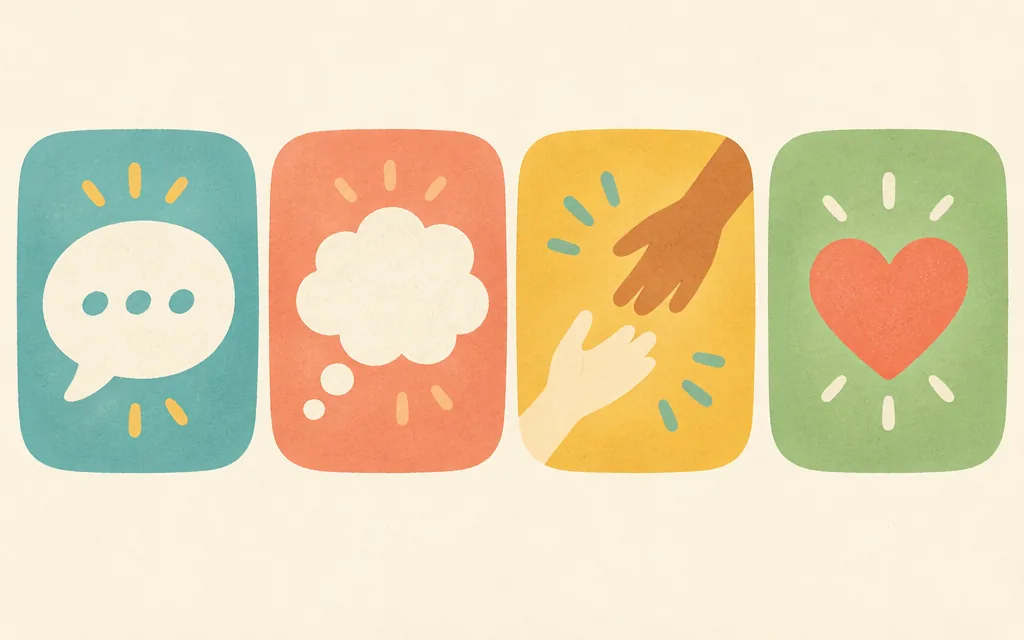
Use words like "usually", "sometimes" and "might". Real life changes, and a story that promises "the supply teacher will always be kind" or "we will always have PE on Friday" can cause more upset when things go differently. Avoid "I must" and "I must not": a story is not a list of rules.
First or third person? For younger children, first person ("I", "my") often works well. For older children and teenagers, third person or a more article-like style can feel more respectful (see the section on older children below).
Step 5: Make it personal
Teachers and parents often find that using the child's own name and familiar places makes the biggest difference. Use the child's first name (or "I"), the real places they know (the hall, the blue door, the dinner queue), the real people (by role or first name), and their interests. A child who loves trains might find a fire-drill story easier to engage with if the line of children is "like train carriages".
Generic stories can help, but the closer the story matches the child's real day, the more likely it is to make sense to them.
Step 6: Pictures: photos, symbols or illustrations?
There's no single right answer: the picture just needs to be clear and match the words.
- Photos of real places (the classroom, the dentist's waiting room) are concrete and helpful.
- Symbols suit children who already use them.
- Illustrations can show a situation without photos of the child.
You don't need photos of a pupil to make a story feel personal; an illustrated character sharing the child's look and support items can work just as well. Check the pictures with the child, as some find certain images (including AI-generated ones) unsettling.
Step 7: How and when to read it
- Read it at a calm time, before the event: a few days ahead for a big change, the morning of for a small one.
- Read it a few times, and let the child hold it or listen to an audio version.
- Keep it available, then fade it out as the situation becomes familiar.
Before you share your story: a quick checklist
- ☐ It's about one situation.
- ☐ I found out how the child sees it (and asked the people who know them).
- ☐ It mostly describes; there's no more than one gentle "I can try" sentence.
- ☐ It uses "usually", "sometimes" or "might" rather than promises.
- ☐ It's personal: name, real places, interests.
- ☐ Pictures match the words, and no picture shows the child doing something they find hard or are being told off for.
- ☐ It's respectful and kind: I'd be happy for the child (and their family) to read it.
A worked example: "Mia has a supply teacher"
Here is a complete, short social story for a fictional Year 2 pupil, Mia, with each sentence labelled by type. Mia is not a real child; she's an example you can adapt.
| # | Sentence | Type |
|---|---|---|
| 1 | Having a supply teacher | Title |
| 2 | Most days, Mrs Khan is my teacher in Year 2. | Describing |
| 3 | Sometimes Mrs Khan cannot be at school. | Describing |
| 4 | When that happens, a supply teacher usually comes to teach our class. | Describing |
| 5 | A supply teacher is a real teacher who visits for a day or a few days. | Describing |
| 6 | The supply teacher wants our day to go well. | Perspective |
| 7 | They might do some things a little differently, like reading the register in a new order. | Describing |
| 8 | Mr Jones, our TA, usually stays with our class. | Describing |
| 9 | Lots of things stay the same: my peg, my seat, playtime and lunch. | Reassuring |
| 10 | Some children feel a bit unsure when there is a new teacher. That is OK. | Perspective / reassuring |
| 11 | If I have a question, I can try asking Mr Jones or the supply teacher. | Coaching |
| 12 | Mrs Khan will come back soon. | Describing (only use if true) |
Notice how little the story tells Mia what to do. Eleven of the twelve lines explain; one offers a choice.
Free template you can copy
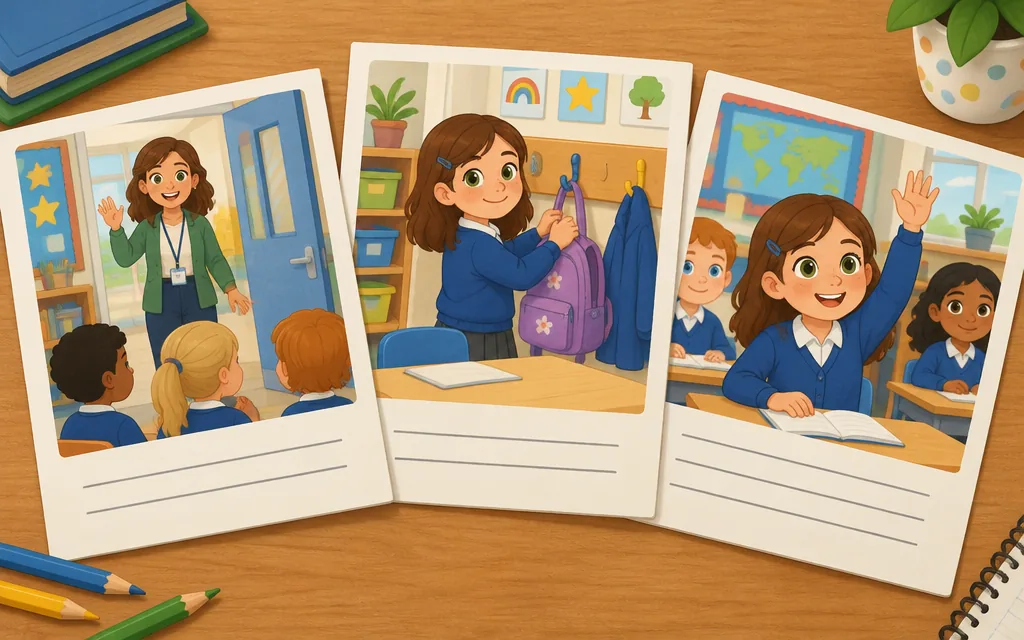
Copy this into a document and fill in the blanks. Delete any line that doesn't fit.
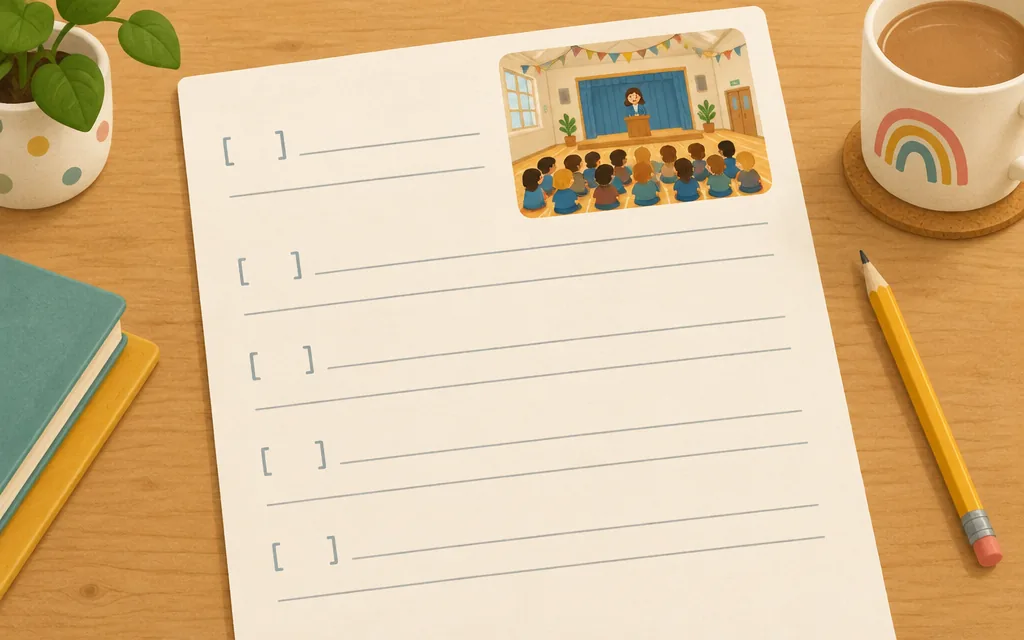
Title: [Situation, e.g. Going to assembly]

Sometimes / Most days, I [what happens].
This happens at/in [real place].
[Who is there] are usually there.
First, [what usually happens].
Then, [what usually happens next].
It might be [noisy / busy / different] because [reason].
[Person] wants [positive goal for everyone].
Some children feel [feeling] when [situation]. That is OK.
If I feel [feeling], I can try [one gentle choice].
[Reassuring ending, e.g. After assembly, we go back to class.]
Want a heads-up before the tricky moments come round? Get the free Tricky Moments Calendar: 10 printable A4 pages listing 40+ changes to prepare pupils for, term by term and on any day (like supply teachers and fire drills), with a story starter for each, a year-at-a-glance wall page and a one-page story planner. No pupil information needed.
Who are social stories for?
Social stories are most closely associated with autistic children and young people, but they can help any child who finds change, new situations or social expectations confusing, including children with other special educational needs, anxiety, or simply a big change ahead.
Every child is different, and that includes every autistic child. The best story is shaped around the individual child, not a diagnosis.
Using them in EYFS, KS1 and KS2
| Stage | Typical length | Pictures | Tips |
|---|---|---|---|
| EYFS / Reception | 4–8 short pages, 1 sentence per page | Large, clear pictures or photos of real places | Read together often; keep the language very simple |
| KS1 | 6–10 pages, 1–2 sentences per page | Illustrations, photos or symbols | Use the child's name and real places; add one "I can try" |
| KS2 | 8–12 pages or a single sheet | Smaller pictures, more text | Invite the child to help write it; explain reasons more fully |
These are starting points: go by the child's reading level and attention, not their age.
Neuro-affirming social stories: understanding, not compliance
Some parents worry that social stories are a way of making autistic children behave in ways that suit adults. That concern deserves to be taken seriously. Used badly, a story can become a set of rules that asks a child to hide distress or mask who they are; the National Autistic Society warns against approaches that train autistic people to mask.
Used well, a social story does the opposite. It shares information so the child can understand what's going on, and it respects their perspective and feelings. Gray's current criteria emphasise description over direction and celebrating what a child does well. A neuro-affirming story:
- explains, rather than shames;
- treats sensory needs as real ("The hand dryer is loud. I can use paper towels instead.");
- offers choices and supports, not just expectations;
- includes stories that celebrate the child's strengths, not only problems to fix.
Never picture the child doing the behaviour you want to stop. A story showing a child hitting classmates, for example, can feel humiliating and may reinforce the very image you're trying to move away from. Show what helps, not what went wrong.
Social stories for transitions and change
Transitions are where social stories are most often used: starting school, moving class, holidays, a new sibling, even the daily handover at the gate. For any change, start the story early, use real photos of new places if you can get them, and be honest about what will be different and what will stay the same.
Starting school or Reception
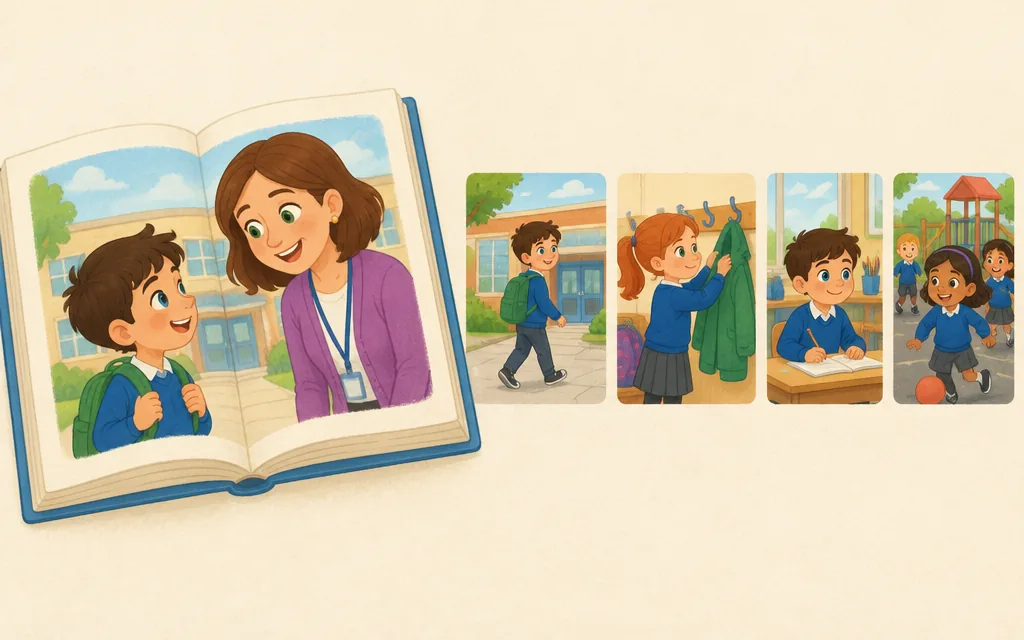
Ask the school for photos of the classroom, the cloakroom, the toilets and the playground, and the names (and ideally photos) of the teacher and TA. A story about "my new school" can then be read over the summer. Include the practical things: where my coat goes, where lunch happens, who picks me up.
Moving class in September and Year 6 to secondary
For a new class, a short story about the new room, teacher and routine works well in the last weeks of the summer term. For the move from Year 6 to Year 7, many councils and secondary schools publish transition stories and photo booklets. A personalised version might cover the bus or walk, the bigger building, timetables, moving between lessons, and who to go to for help. Older pupils often prefer this as a guide they help write.
Holidays, a new baby and the school gate
The same approach works for school holidays, trips and flights, a new baby at home, and the daily pick-up and drop-off. Walk through each stage honestly, say what will stay the same, and use stories alongside practical adjustments agreed with the school, not instead of them.
Social stories for behaviour, emotions and friendships
Social stories can help children understand social situations and feelings, both their own and other people's, but they work best when they explain rather than tell off. If a story is being written because of a behaviour, start by asking what the child doesn't understand or finds distressing; the behaviour is often a sign of that.
Friendships and playtime
A fictional scenario: Jay, in Year 4, keeps taking over games at playtime, and his classmates have started leaving him out. His teacher wonders whether a social story could help him understand how his friends feel.
It can, if it's written kindly. A story for Jay might describe how playground games usually work, that friends often take turns choosing, and that people feel happy when they get a turn to decide. It might add one "I can try" line ("I can try asking, 'What shall we play?'"). It shouldn't list everything Jay has done wrong. Pair it with adult support at playtime, structured games, and conversations with the wider class too. Friendship is a two-way thing.
Big feelings and calming down
Stories about feelings can describe what a feeling might be like in the body ("When I feel worried, my tummy might feel funny"), when it sometimes happens, and what helps. Make the calming options real and available: a quiet corner, a fidget, a trusted adult.
Ready-made stories, templates and tools
You can write social stories by hand, adapt free templates from councils and NHS services, use general tools like Google Slides or Canva, or use a dedicated social story tool or AI tool. Each has its place; the right one depends on your time, how personal the story needs to be, and your school's approach to pupil data.
- Free council and NHS PDFs: reliable and free, especially for transitions. Usually generic.
- Resource websites: large libraries of ready-made stories. Quick, but rarely personal.
- Making your own in Slides, Word or Canva: fully personal, but it takes time, and finding the right picture can be the slowest part.
- Dedicated apps and AI tools: faster personalisation. Check how each tool handles pupil information, whether it asks for photos, and whether you can edit everything before using it.
Why generic stories often don't land
A ready-made story may show a dentist, a room or a child that looks nothing like the real one, and for many children that mismatch is confusing. Personalising names, places and details is often what makes a story make sense.
Making stories with ReadyStories
ReadyStories is a social story tool for UK primary and special schools, built by Conor, a teacher. You describe what's coming up, and it writes and illustrates a personalised story for your pupil in minutes, inspired by Carol Gray's Social Stories™ approach. Each pupil appears as an illustrated avatar that staff choose, including support items such as ear defenders, hearing aids or a wheelchair, so no pupil photo is ever needed. You can review and edit every story before you read, print or share it. There's also a ready-made library for everyday moments such as fire drills, assemblies and wet play.
ReadyStories is free during the beta, with no card needed. Schools that join during the beta can lock in a founding price of £249 a year (see pricing). You can read how pupil information is handled on our data and safeguarding page.
Social stories for older children and teenagers
Social stories can absolutely work for older children and teenagers, but they need to look and sound grown-up. A story that feels babyish can feel insulting, and a young person who feels talked down to is unlikely to engage.
Change the format to a one-page guide, bullet points, a phone note or a slideshow, and:
- use real photos of places rather than cartoon characters;
- give more reasons and choices, and consider the third person;
- co-write it with the young person, who is the expert on what they find hard.
Do social stories work? What the evidence says
The evidence is mixed: social stories are best seen as one useful support for specific situations, not a cure-all. The largest UK trial found no overall change in social responsiveness, but more children met the specific goals their stories were written for.
That trial, ASSSIST2 (Autism Spectrum Social Stories in Schools Trial 2), was a randomised controlled trial in 87 UK primary schools with 249 autistic children aged 4–11, following Carol Gray's method and delivered by school staff, most often TAs. Its findings were published in an NIHR report (2024) and a journal paper (2025):
- There was no significant difference in overall social responsiveness (the trial's main measure) at six months, and no significant differences in anxiety, depression, general health or parental stress.
- Children who had social stories met their individual goals more often than children who didn't.
- The researchers described social stories as a low-cost approach.
- The COVID-19 pandemic disrupted the trial, and many children didn't receive all their sessions, which the authors note may have reduced the effect.
In plain terms: social stories are unlikely to transform a child's overall social skills on their own, but they may help with the particular situation a story is written about. That fits how most teachers and parents use them.
Why a first attempt might "flop", and what to try next
If your first social story didn't seem to work, you're not alone, and it doesn't mean they can't help. Common reasons:
- Too long. Cut it down to the essentials.
- The wrong moment. Reading it mid-meltdown won't help. Try a calm time, earlier.
- Too much telling. If it reads like a list of rules, rewrite it to describe more and direct less.
- Not personal enough. Add the child's name, real places and interests.
- Read once only. Most stories need repeating, over days or weeks.
- It's the wrong problem. Go back to Step 2: what does the child actually find hard?
And sometimes a story isn't the right tool. If a child is very distressed, talk to your SENCO, the child's family and any professionals involved.
Frequently asked questions
What is a social story?
A social story is a short, personalised story that explains a situation, what usually happens and what other people might think or feel. It mainly describes rather than directs, so a child can understand something new or confusing.
Who created social stories?
Social stories were developed by Carol Gray, an American teacher and consultant, in the early 1990s. "Social Stories™" is her trademark, and she publishes formal criteria for writing them, most recently the 10.4 criteria (2023).
How long should a social story be?
As long as it needs to be and no longer. For young children or early readers, that might be four to eight short pages with one sentence each. For older pupils it might be a single page or a short guide. Focus on one situation and cut anything the child doesn't need to know.
Should a social story be written in first or third person?
Either can work. First person ("I", "my") is common for younger children because it helps them see the story as about them. Third person, or a more neutral, guide-like style, often suits older children and teenagers, who may find "I" stories childish. Let the child's age, preference and reaction guide you.
How often should you read a social story with a child?
Read it a few times at a calm moment before the situation happens, for example once a day in the week before a school trip. As the situation becomes familiar, read it less often and let it fade.
Do social stories work for non-verbal children?
Yes, they can. Children who don't use speech can still benefit from the information a story shares. Read it aloud, record it as audio, pair it with symbols the child already uses, or put it on their AAC device or tablet. Watch how the child responds and adapt the format to suit them.
Do social stories work?
The evidence is mixed. A large UK trial, ASSSIST2, with 249 autistic children in 87 primary schools, found no significant change in overall social responsiveness, but children with social stories met their individual goals more often. They're best seen as a low-cost support for specific situations rather than a cure-all.
Is there a free social story template or app?
Yes. There's a free fill-in-the-blanks template earlier in this guide, and many councils and NHS services publish free social story PDFs. You can also build stories in Google Slides or Canva. If you'd like personalised, illustrated stories made for you, ReadyStories is free during the beta with no card needed, and you can review and edit every story.
Can I use photos of the child in a social story?
Families sometimes do, but schools should think carefully about privacy and their own policies before using photos of pupils, especially in digital tools. Photos of the places involved can be very helpful. To show the child, illustrations or avatars that share their look and support items can feel just as personal.
Are social stories suitable for teenagers?
Yes, if they're adapted. Use a grown-up format, such as a one-page guide, bullet points or a note on their phone, with real photos rather than cartoons and more explanation of why things happen. Best of all, write it with the young person, so it answers the questions they actually have.
In summary
- Social stories share information about a situation, calmly and positively, so a child can understand it.
- To write a social story, choose one situation, see it from the child's side, describe more than you direct, and make it personal.
- The evidence suggests they're a useful, low-cost support for specific goals, not a cure-all.
Making stories for pupils at your school?
Parents and carers: get the free Tricky Moments Calendar, and share this guide with your child's teacher or SENCO.